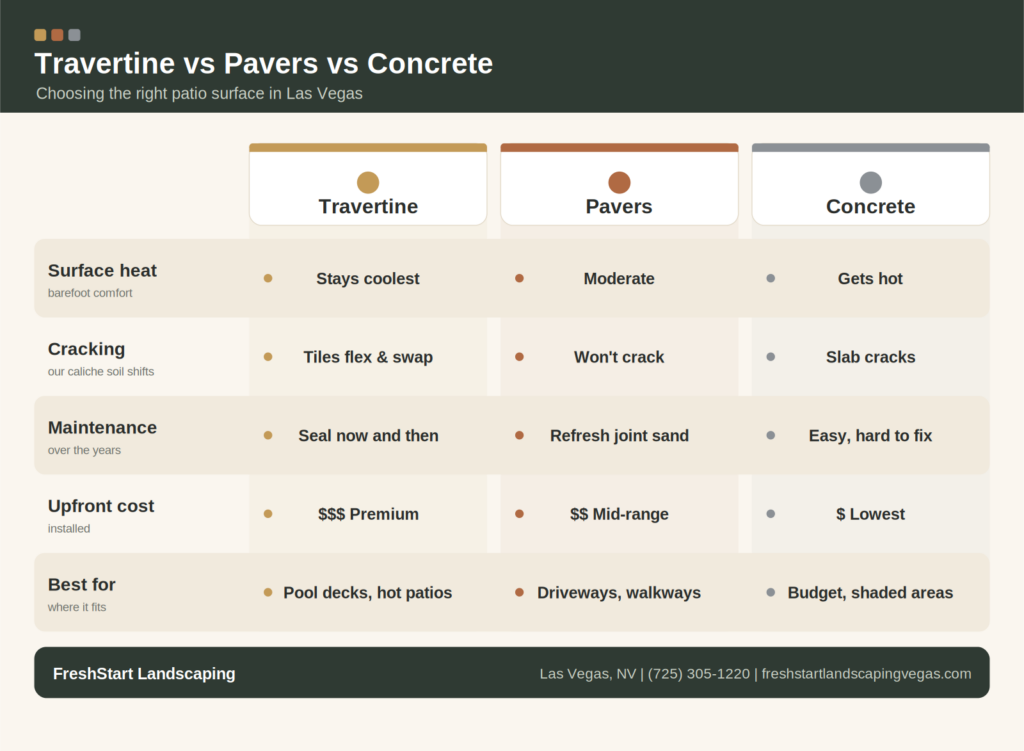
When homeowners plan a patio, walkway, or pool deck in Las Vegas, the choice usually comes down to three materials: travertine, pavers, or poured concrete. They all work here, but they do not perform the same way under our sun, and the differences matter once you are standing on the surface in July. Here is an honest look at each.
Surface heat is the first thing to consider
In a climate where summer afternoons sit above 105 degrees, how hot a surface gets is not a small detail, especially around a pool where people walk barefoot.
Travertine is a natural stone that stays noticeably cooler than concrete. It does not absorb and hold heat the same way, which is why it is so popular for pool decks and patios used in the afternoon. Pavers fall in the middle and depend on the color and material you pick. Lighter pavers stay cooler than dark ones. Standard gray concrete absorbs a lot of heat and can get uncomfortable to stand on midday.
If barefoot comfort is a priority, travertine has the clear edge, with light-colored pavers as a strong second.
Durability and how each handles our ground
Las Vegas soil moves. We sit on caliche, a hard cement-like layer, and the ground expands and shifts with temperature. That movement is what cracks patios over time.
Poured concrete is a single slab, so when the ground shifts, it tends to crack, and a crack in concrete is permanent unless you cut and repair it. Pavers are individual units set over a compacted base, so they flex with ground movement instead of cracking, and if one ever gets damaged you can lift and replace that single piece. Travertine, when installed over a proper base, holds up well to heat and sun and lasts for decades, and like pavers, individual tiles can be swapped if needed.
For a surface that ages well with our soil, the segmented options, pavers and travertine, have a real advantage over a single concrete pour.
Maintenance over the years
Concrete is low effort up front but hard to fix attractively. Once it cracks or stains, patching rarely blends in, and many homeowners end up resurfacing or replacing.
Pavers need occasional attention to the joints, the sand between units, and a wash now and then. Sealing is optional and extends the look. Travertine benefits from periodic sealing to guard against staining, but it is otherwise easy to live with. Both pavers and travertine let you address a small problem area without redoing the whole surface, which concrete does not.
Cost and long-term value
Concrete is usually the lowest cost to install, which is why it is the default for builders. Pavers cost more up front, and travertine is typically the premium of the three. The gap narrows when you look past installation day. Concrete that cracks and gets replaced can cost more over ten years than a paver or travertine surface that simply gets a repair here and there.
There is also resale to think about. A travertine or paver patio reads as an upgrade to buyers in the Las Vegas market, while plain concrete reads as standard. If you plan to sell down the line, the better surface tends to hold its value.
A simple way to decide
- Choose travertine if you want the coolest surface underfoot, a high-end look, and a pool deck or patio you will use in the heat.
- Choose pavers if you want strong durability, design flexibility with colors and patterns, and easy spot repairs at a more moderate cost.
- Choose concrete if budget is the main driver and the area is low-traffic or out of direct afternoon sun.
Most of the backyards we build use a mix, for example travertine around the pool and pavers for the walkways and driveway, so each area gets the right material for how it is used.
If you are weighing these options for your own yard, we install both travertine and pavers and can walk you through what fits your space and budget as part of our hardscaping work. Call (725) 305-1220 to set up a free consultation.